Does your kitchen trash can smell bad the day after you empty it? The culprit isn’t necessarily your bag, but the fermentation of organic waste that starts much faster than we imagine. Yet there’s a simple trick, costing less than a euro, that solves the problem in just one day.
This trick is baking soda. This everyday product acts as a true odor neutralizer, without artificial fragrance or harsh chemicals. Here’s how to use it correctly to get a fresh-smelling kitchen without thinking about it every day.
Why your kitchen trash can smells bad (even with a new bag)
Bad odors don’t come only from visible waste. They arise mainly from moisture that stagnates at the bottom of the trash can, between the bag and the wall. Peels, food scraps, and damp packaging release juices that accumulate and begin to ferment, especially when the temperature rises in the room.
A garbage bag, however thick, doesn’t completely block the odor molecules that form during this decomposition. This is why a trash can can smell bad as early as the second day, even if changed regularly.
Baking soda: the odor neutralizer under 1€
Baking soda doesn’t mask odors like a conventional air freshener—it literally absorbs them. Its chemical structure allows it to capture the acidic molecules responsible for unpleasant smells, particularly those produced by the fermentation of food scraps. It’s a natural, effective moisture absorber and completely safe for the kitchen.
For just a few cents, this white powder is a far better alternative to scented sprays that only temporarily cover the problem without ever solving it at the source.
How to apply the trick in 3 steps (and see results within 24 hours)
The method is intentionally simple, designed to be adopted as a daily habit without hassle. Just follow these three steps in order.
- Empty the trash can completely and clean the bottom with some diluted white vinegar to remove sticky residue and bacteria.
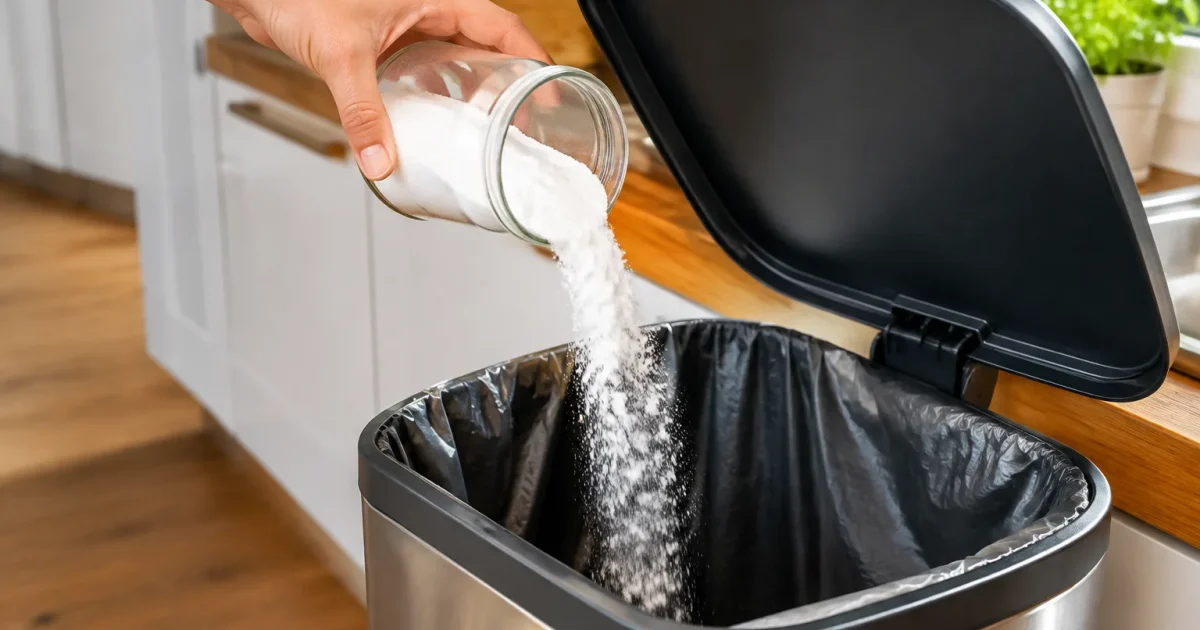
- Generously sprinkle one to two tablespoons of baking soda directly at the bottom of the trash can, before putting in a new garbage bag.
- Repeat the operation each time you change the bag, paying special attention underneath the bag, where moisture most often seeps in.
By the next day, the air around the trash can is noticeably fresher. Baking soda continues to work as long as it stays dry, which is why you should avoid getting it wet directly.
The mistake that cancels out baking soda’s effect
Pouring baking soda onto a still-damp trash can bottom turns it into an ineffective paste. It must always be applied to a dry surface to properly absorb future odors.
The baking soda and coffee grounds duo for hot weather periods
When temperatures rise, fermentation speeds up and baking soda alone may reach its limits. This is where coffee grounds come in, a natural ally that perfectly complements baking soda’s action. Once dried and placed at the bottom of the trash can, it absorbs moisture and brings a neutral scent that slightly masks the most stubborn smells.
This baking soda and coffee grounds duo works particularly well during summer, when organic waste breaks down in just a few hours. Simply mix the two powders in equal parts and reapply every two or three days.
Complementary steps to keep your trash can fresh
Baking soda works best when combined with a few simple habits. Half a lemon rubbed on the inner walls provides immediate freshness after cleaning, while a few drops of essential oils (tea tree or lemon) placed on cotton can be slipped under the lid to extend the effect.
Also remember never to leave a full bag longer than two days in summer, to always close the lid between uses, and to wash the trash can itself once a week with white vinegar. This budget-friendly trick, combined with regular cleaning, permanently transforms a smelly trash can into a discreet kitchen element.

- Le rangement d’hôtel qui remplace le dressing sur mesure à 4 000 € dans toutes les chambres - 17 September 2026
- Ces déchets de cuisine remplacent tous les engrais du commerce, gratuitement - 17 September 2026
- Citron caviar en pot sur un balcon : comment le cultiver et récolter ses perles - 17 September 2026