Your tulips fade in three weeks, your annuals demand daily watering, and the flower bed goes empty by July. There’s a solution to this frustrating cycle, and it has a name few gardeners know yet: hardy geranium, particularly the Rozanne variety. This plant blooms without interruption from April through the first frosts, requiring almost no maintenance.
Despite common misconceptions, this is neither a rare nor delicate plant. It’s a hardy perennial, robust and capable of surviving a dry summer without complaint, reflowering every year without replanting. That’s why it deserves a place in any flower bed, even for the busy gardener.
The forgotten perennial that blooms for 6 months straight: portrait of an underrated star
Hardy geranium Rozanne (not to be confused with pelargonium, often mistakenly called geranium) forms a flowering carpet of blue-violet veined blossoms carried by decorative, deeply cut foliage that remains attractive all season. Its defining characteristic is its extended blooming period, which starts in May and continues without pause until the first autumn frosts.
This generosity stems from its ability to continuously produce new buds, requiring neither deadheading nor removal of spent flowers. Other overlooked perennials follow similar logic, like gaura, whose delicate stems sway in the breeze all summer, or coneflower, prized for its large cone-shaped flowers that attract pollinators. Aster takes over late in the season and closes the cycle just before winter arrives.
Why this perennial outperforms tulips and annuals: 3 major advantages
The first advantage is duration. A tulip blooms for three weeks, an annual must be replanted each year: hardy geranium flowers for six consecutive months, without interruption or replacement.
The second advantage is drought resistance. Once established, the plant tolerates prolonged dry periods thanks to a deep root system that seeks moisture below the surface. It requires far less water than a typical annual flower bed, making it an intelligent choice for regions with hot summers.
The third advantage is its pollinator-friendly nature. Flowers attract bees and butterflies all summer long, a genuine bonus for garden biodiversity, without requiring special treatment against disease or pests.
When and how to plant for guaranteed blooms from spring through frost
The right timing for your climate
Planting happens ideally in March-April or September-October, depending on your region. In mild-winter zones, autumn is preferable since the plant benefits from moisture to establish strong roots before cold arrives. In colder regions, wait until spring to prevent frost from weakening young roots.
Coneflower and aster follow the same timeline, while gaura, more sensitive to cold and moisture, prefers spring planting to have time to establish before the following winter.
Key planting steps: soil, spacing, and initial care
These perennials require well-draining soil, light in texture, optionally enriched with a bit of compost at planting time. Standing water remains their root system’s worst enemy, far more than lack of water.
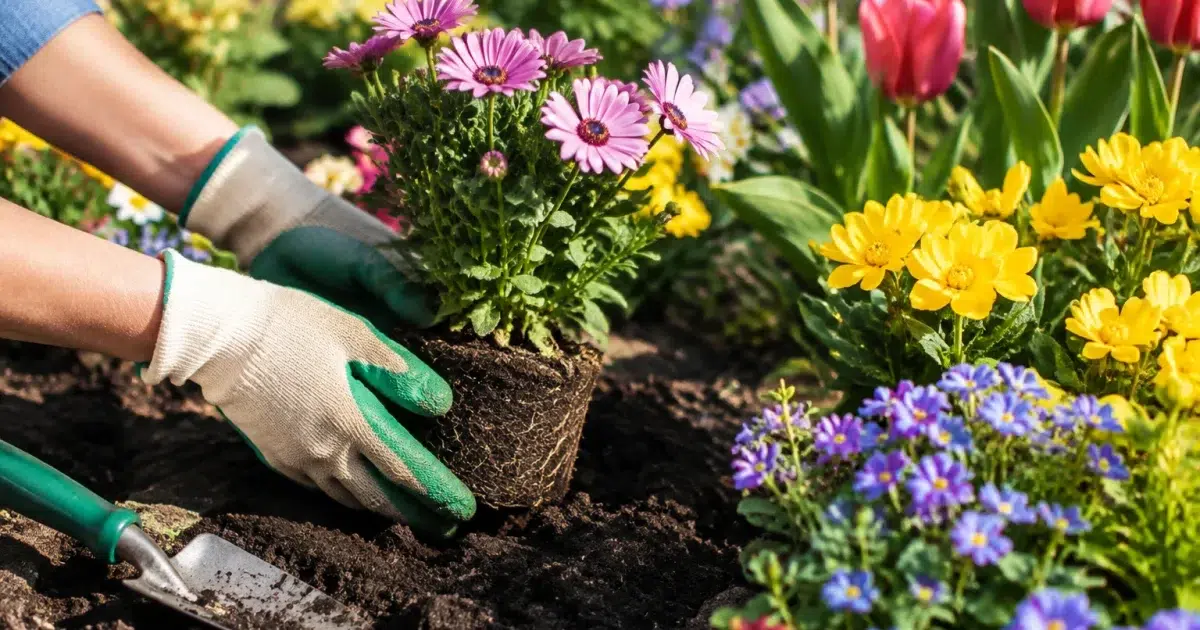
- Dig a hole twice as wide as the root ball, loosen the bottom to promote drainage.
- Space plants 30 to 40 cm apart to allow the plant to spread naturally into a flowering carpet.
- Water generously at planting, then gradually reduce watering once the plant is established.
- Apply a light mulch to limit evaporation during the first weeks.
Full sun suits hardy geranium and coneflower perfectly, while gaura tolerates light partial shade without losing bloom quality.
The classic mistake with hardy geranium
Many gardeners overwater after planting, thinking they’re helping. Result: roots rot before they’ve had time to establish. Generous but spaced-out watering works much better than light daily watering.
Easy maintenance: what you really need to do… or not
Once established, maintaining these perennials requires only a few simple tasks. A light trim in late winter is enough to stimulate vigorous new growth in spring. There’s no need to remove spent flowers throughout summer; the plant keeps blooming without this tedious chore.
Every three or four years, dividing the clump revitalizes the plant and produces new plants for free. This is done in spring or autumn by separating the roots with a spade or knife, then replanting each division in soil prepared the same way as the original planting.
Essential varieties and winning plant combinations for a spectacular bed
Beyond hardy geranium Rozanne, several other varieties deserve a place in a flower bed designed to bloom continuously. Combining these plants staggeres the blooms and creates volume right from early spring.
| Perennial | Blooming period | Exposure |
|---|---|---|
| Hardy geranium Rozanne | May to October | Full sun / partial shade |
| Gaura | June to October | Full sun |
| Coneflower | July to September | Full sun |
| Aster | September to November | Full sun / partial shade |
By combining these four perennials in the same bed, blooming begins in spring with geranium and ends with aster just before the first frosts. The result is a continuous carpet of flowers, with no empty spaces or dead periods, all without demanding heavy maintenance throughout the season.

- Le rangement d’hôtel qui remplace le dressing sur mesure à 4 000 € dans toutes les chambres - 17 September 2026
- Ces déchets de cuisine remplacent tous les engrais du commerce, gratuitement - 17 September 2026
- Citron caviar en pot sur un balcon : comment le cultiver et récolter ses perles - 17 September 2026