A dog that disappears, a teenager’s heartache, and then wooden boards stacking up in a garage. That’s how, several years ago, the story began of a young man who ended up building 750 birdhouses. Today, his entire neighborhood echoes with the song of tits and songbirds. Here’s what happened, and how you can replicate this gesture at home, even on a small scale.
A touching story: a teenager builds 750 birdhouses after losing his pet
At 12 years old, he loses his dog. The emptiness he feels, he decides to fill it differently: by building a birdhouse with whatever he has on hand, to provide shelter for a garden bird. This first gesture, almost therapeutic, quickly transforms into a long-term project. Year after year, he refines his designs, tests different types of wood, adjusts the birdhouse placement based on what he observes in return.
The result far exceeds what he imagined at the start. 750 shelters have been placed throughout his neighborhood, at neighbors’ homes, in schools, on balconies. Blue tits, robins, and other songbirds gradually recolonized streets where they were no longer heard. This committed young man has become, without seeking it out, a local figure in nature conservation.
Why this gesture resonates in France: the decline of garden birds
This story touches people because it arrives at just the right moment. The decline of garden birds has been documented for years by the LPO (French League for Bird Protection), which regularly alerts about the collapse of common songbird populations in urban and suburban areas. Disappearing hedgerows, scarcity of natural cavities in old trees, pesticides: the causes pile up and make nesting increasingly difficult for many species.
Faced with this reality, citizen initiatives are sprouting up everywhere. Installing a bird shelter in your garden, however modest, directly contributes to local biodiversity. It’s this type of citizen movement, made up of small accumulated gestures, that is beginning to reverse the trend in some neighborhoods, like that of this teenager turned young adult (somewhat like these beavers that brought wildlife back by building a dam).
Get inspired at home: the 5 essential rules for installing a birdhouse
Installing a birdhouse shouldn’t be completely improvised. A few simple rules make all the difference between a shelter occupied come spring and a wooden box that remains empty all year.
Choice of location and orientation
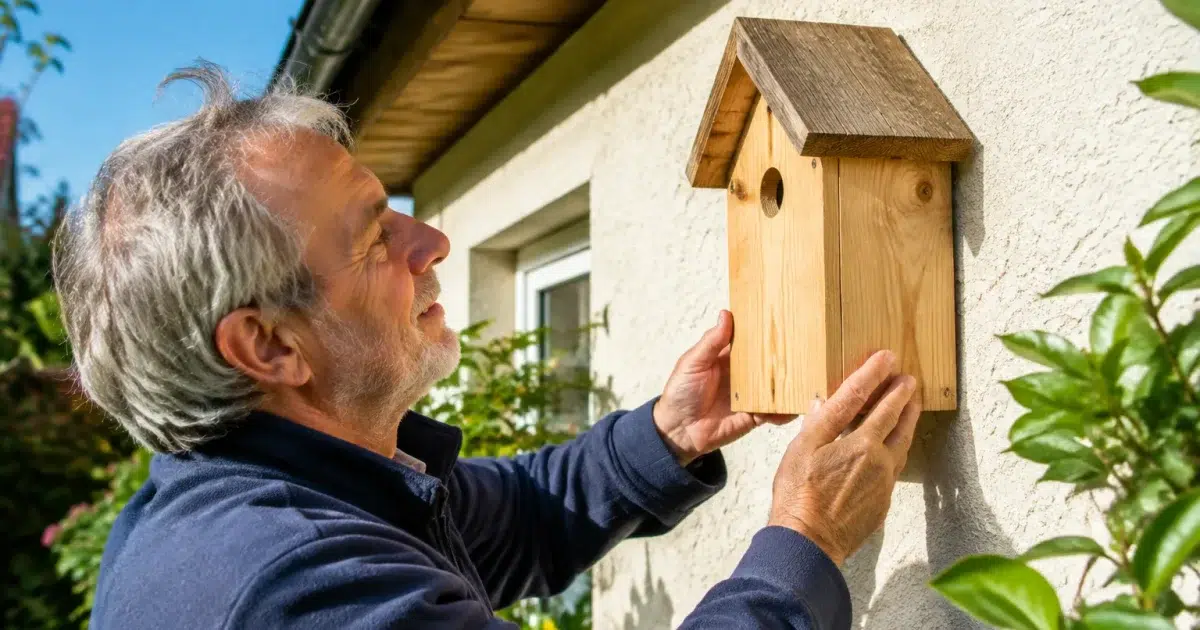
The birdhouse location must offer tranquility: avoid areas with too much foot traffic or exposed to predators (cats, squirrels). The orientation of the birdhouse also matters a lot: favor an entrance facing between east and southeast, protected from dominant winds and driving rain, but never in full afternoon sun which would overheat the interior during nesting season.
Height and installation of the birdhouse
The birdhouse height varies depending on the target species: between 2 and 4 meters from the ground for most tits and songbirds, slightly lower for robins which prefer cavities close to the ground hidden in vegetation. Secure it firmly against a trunk or wall, tilted slightly forward to prevent water from seeping in.
| Species | Flight hole diameter | Recommended height |
|---|---|---|
| Blue tit | 28 mm | 2 to 4 m |
| Great tit | 32 mm | 2 to 4 m |
| Robin | open / semi-open | 1 to 2 m |
| House sparrow | 32 to 35 mm | 3 to 5 m |
These benchmarks, widely shared by the LPO, apply equally well to a traditional garden or a city balcony, provided you leave a bit of vegetation nearby so wildlife feels safe there.
Placing a perch in front of the flight hole seems practical, but it makes access easier for predators. Birdhouses validated by the LPO intentionally don’t have one.
Maintain your birdhouse to welcome birds every year
Birdhouse maintenance happens once a year, in autumn, once the nesting season is over. Remove the old materials (moss, twigs, feathers), inspect cracks and replace damaged wood if needed. A simple rinse with clear water is enough: avoid chemicals that could permanently deter future occupants.
This simple annual gesture ensures that the shelter remains healthy and welcoming season after season. It’s also an opportunity to observe what worked or didn’t, and to adjust the birdhouse location for the next year. Many families transform this ritual into a moment of environmental awareness with their children, much like what this young man experienced at the beginning.
Welcoming wildlife to your garden doesn’t require a vast property or a significant budget. A patch of moss, a hedge spared from the mower, a few well-placed birdhouses, and an ecological garden begins to take shape. The story of these 750 shelters reminds us that an individual gesture, born from heartache, can end up changing the face of an entire neighborhood.

- Le rangement d’hôtel qui remplace le dressing sur mesure à 4 000 € dans toutes les chambres - 17 September 2026
- Ces déchets de cuisine remplacent tous les engrais du commerce, gratuitement - 17 September 2026
- Citron caviar en pot sur un balcon : comment le cultiver et récolter ses perles - 17 September 2026