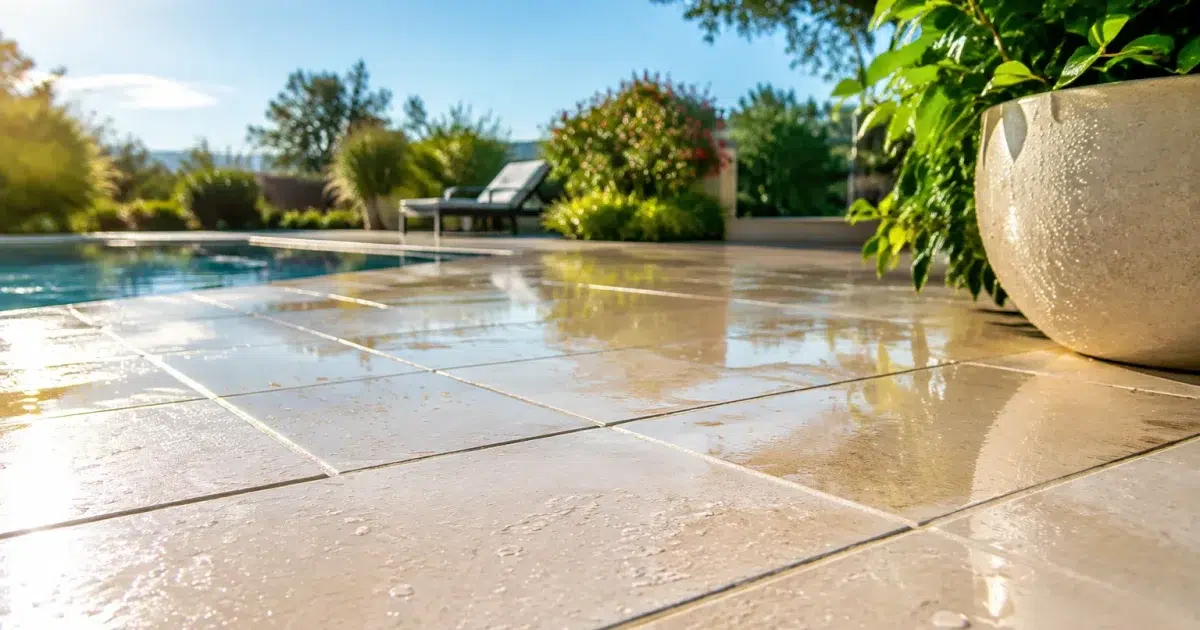
On the day of installation, I was proud of my choice. A light stone, almost white, meant to brighten my shaded courtyard and create a cozy feel as spring arrived. Three weeks later, one October morning at 11 degrees Celsius, I stepped barefoot onto it while heading out for coffee. The sensation was glacial, almost burning in reverse. That’s when I realized I’d overlooked something essential.
That something was the thermal conductivity of light-colored stone. This type of material releases ambient cold much faster than dark stone or composite wood. In the early morning, the terrace becomes a genuine thermal trap: it has accumulated the night’s cold and releases it directly through skin contact. It was exactly the opposite of what I was aiming for by betting on brightness.
Why my light stone terrace became icy at 11 °C
Light-colored stone has different thermal inertia than dark shades. It stores less heat during the day, so it releases less heat at night to compensate for morning coolness. Result: the ground stays cold longer after sunrise, especially in shaded areas or under covered zones. I tested it with a surface thermometer one autumn morning: 9 degrees on the light stone, versus 14 on a neighboring gray tile that had been in the sun for a few hours.
Another phenomenon at play is light reflection. A light surface reflects light instead of absorbing it, which explains the desired brightness initially. But this same reflection amplifies the visual and physical sensation of cold in the morning, before the sun truly warms up. In full summer, this same mechanism reverses and becomes another problem: summer heat reflects violently, causes glare, and heats the surrounding air instead of tempering it.
The design mistake I didn’t see coming
My error wasn’t choosing light-colored stone, but thinking only about aesthetics and brightness without anticipating the material’s thermal behavior across seasons. No one had mentioned albedo, the coefficient that measures a surface’s ability to reflect light and heat. The higher the albedo, the more a light surface reflects energy instead of storing it, which affects both morning thermal comfort and daytime overheating.
I had also underestimated my terrace’s exposure. Facing northeast, it stays in shadow a good part of the morning, prolonging the cold sensation on the light stone. A sunnier orientation would likely have limited the effect, but wouldn’t have completely eliminated the problem linked to the material’s thermal conductivity itself.
The classic “light at all costs” mistake
Many homeowners choose light stone purely to visually enlarge a shaded space, without researching the stone’s finish or its behavior outside peak sunlight hours. A softened or sandblasted finish slightly limits reflection, unlike a polished finish which amplifies it.
How to fix an overly light terrace without demolishing it
Good news: concrete solutions exist without complete replacement. The first thing to do is break the exposure to direct cold and raw light, rather than attacking the material itself.
Create shade and add vegetation
A lightweight pergola already makes a real difference. It limits reflection during peak summer heat while maintaining a bright, open space. Combined with vegetation around the terrace—shrubs, planters, climbing plants—it creates a buffer zone that softens temperature swings between night and morning. I added two bamboo planters on the northeast side of my terrace: the effect on morning cold sensation is real, though gradual.
Add intermediate coverings
For immediate effect, a moisture-resistant outdoor rug or wooden grating placed in walkways is enough to break direct contact with the light stone. It’s the quickest and least expensive solution, ideal while awaiting a more permanent fix. Some also opt for a specific surface treatment that slightly reduces perceived thermal conductivity without changing the terrace’s visual appearance.
What you need to know before choosing light stone for your terrace
If I were to redo this project, I’d ask my contractor precise questions before validating anything. The choice between natural and reconstructed stone already makes a big difference: reconstructed stone often has slightly more stable thermal conductivity because its composition includes binders that limit sharp temperature swings.
The table below summarizes the criteria that really make the difference between a comfortable outdoor surface and one that becomes a thermal trap.
| Criterion | Effect on comfort |
|---|---|
| Polished finish | Amplifies reflection and morning cold |
| Softened or sandblasted finish | Slightly reduces mirror effect |
| Light natural stone | Low thermal inertia, rapid cold release |
| Alternative materials (composite wood, dark sandstone) | Better day-night regulation |
Planning ahead remains key to avoiding this kind of disappointment. It’s not about giving up brightness, but combining it with consideration of orientation, finish, and available shaded areas around the house. A terrace designed for all seasons prevents you from waking up on a cool morning or during a heat wave wishing you’d chosen differently based purely on looks.

- Ces déchets de cuisine remplacent tous les engrais du commerce, gratuitement - 17 September 2026
- Citron caviar en pot sur un balcon : comment le cultiver et récolter ses perles - 17 September 2026
- Cet arbre à floraison rose fuchsia spectaculaire se plante maintenant - 17 September 2026