Six months. That’s all it took for a pair of beavers released in March to transform a quiet stream. A dam, a pond, birds returning, frogs singing where there was once nothing. The story sounds too good to be true, but it’s happening everywhere beaver reintroduction takes place.
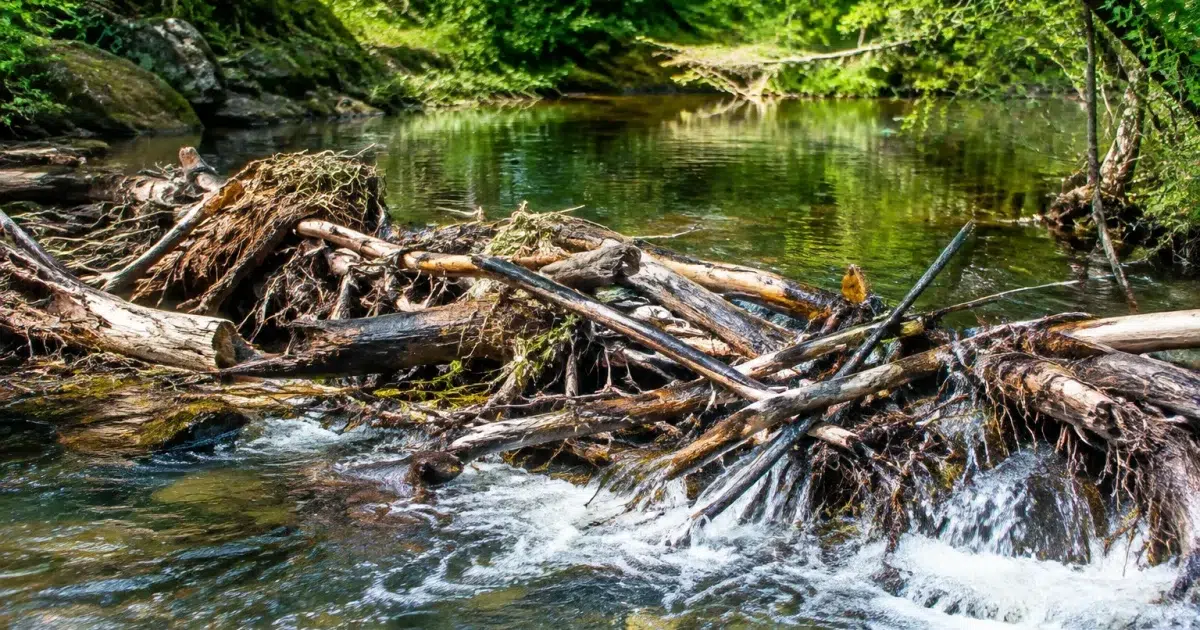
The answer lies in one image: where two animals settle, water stops flowing straight. It spreads, slows down, seeps in. The beaver dam acts like a natural valve that transforms a trickle of water into a thriving wetland. Within weeks, the streambed changes shape, and with it comes a whole parade of species moving back in.
Two beavers released: a dam built in six months and an ecosystem transformed
The scenario is almost always the same. A pair of European beavers is released in spring into a degraded waterway, often too straight, too fast, too sparse in vegetation. Within weeks, the animals spot a strategic location and start piling branches, mud, and stones to slow the current.
After six months, the landscape looks nothing like what it was. The stream, once narrow and entrenched, widens and forms a mosaic of shallow ponds. The newly created wetland attracts dragonflies, amphibians, then waterfowl. It’s no accident that beavers are nicknamed ecosystem engineers: no other mammal has such a rapid impact on its environment.
How beavers build their dams so quickly
Dam construction follows precise logic. The beaver cuts branches of willow, poplar, or alder, drags them to the chosen spot, and wedges them against the current with mud and stones. The sound of flowing water seems to trigger an instinctive caulking reflex in the animal: as long as it hears water escaping, it keeps filling the gaps.
An active pair can thus erect a structure several meters long in just a few weeks, then maintain and expand it continuously. This ongoing construction project explains why a simple stream transforms into a mosaic of pools in such a short time, without any human intervention needed.
The surprising figure
A single beaver dam can hold several hundred cubic meters of water and raise the level of the surrounding water table by several tens of centimeters, even during dry periods.
Hydrological effects: when the stream widens and retains water
The widening of the waterway is only the visible part of the phenomenon. By slowing the water flow, the dam promotes water infiltration into surrounding soils and recharges the water table—a principle also found in urban contexts with infiltration wells for stormwater. The local water cycle is literally rebalanced: water that was flowing downstream stays in place longer, moistens the banks, feeds neighboring meadows (comparable to water infiltration problems in basements that some homes face).
| Before beavers | Six months later |
|---|---|
| Narrow stream, fast current | Widened waterway, multiple ponds |
| Low water table | Recharged water table, wetter soils |
| Bare banks, little vegetation | Dense vegetation, wetland established |
This water regulation has a direct effect on landscape resilience during extreme events. During heavy rain, the pond acts as a buffer and limits downstream flooding. During dry spells, it continues to feed the stream, while nearby unmodified waterways sometimes dry up completely.
The return of wildlife: why biodiversity explodes around dams
The newly formed wetland quickly becomes a mandatory stopping point for numerous pioneer species. Amphibians colonize the shallow ponds first, followed by aquatic insects, then waterfowl that come to feed and nest. Wildlife returns in successive waves, each new species attracting another.
At studied sites, naturalists often record a doubling or even tripling of observed species in a single season. Biodiversity doesn’t just return: it diversifies, with populations of insects and birds far richer than in stream sections that remained in their natural state without beaver intervention.
The beaver, climate ally: droughts, floods, and ecosystem resilience
In the face of climate change, this ability to store water and slow its flow takes on particular value. Areas worked by beavers weather summer droughts better because water accumulated in ponds and soils continues irrigating vegetation even after weeks without rain. Conversely, during heavy downpours, these same areas absorb part of the impact and reduce downstream flooding risk.
The ecological effects go beyond water management alone. Dry meadows at the periphery benefit indirectly from ambient moisture, while dense bank vegetation promotes carbon absorption in accumulated soils and sediments. This spontaneous restoration, achieved without any machinery or heavy engineering, illustrates just how much reintroducing a single species can restore an entire landscape’s ecological resilience.

- Le rangement d’hôtel qui remplace le dressing sur mesure à 4 000 € dans toutes les chambres - 17 September 2026
- Ces déchets de cuisine remplacent tous les engrais du commerce, gratuitement - 17 September 2026
- Citron caviar en pot sur un balcon : comment le cultiver et récolter ses perles - 17 September 2026